
Know Yourself
Name the money story you inherited, keep what fits, and get clear on the values behind every money decision.


Financial Foundations · On-demand course
Financial Foundations is a self-paced course with four modules and a month of live coaching with Lexi and Delana. You'll look at your real numbers without shame, build a safety net, and set up a money system that fits your life.
$697, or payment plans from $130/month
Avoiding or outsourcing your money feels easier, but it isn't easier in the long run. Not looking costs you peace, because you're running the math in your head constantly.
Not looking costs you options: the job you'd leave, the sabbatical you'd take, the business you'd start if you had financial safety. And avoiding money costs you in your relationships, every time money becomes the source of conflict.
The last week of the month arrives, and you know your checking account is low, so you don't open the banking app. Dinner goes on the credit card, and then the unexpected vet bill does too. You tell yourself you'll sort out your money when things calm down.
Featured story
Annabelle swapped reactive spending for automated savings and spending that matches her values.
Individual results vary.
More stories →What if tending to your finances felt like coming home to yourself?
Daryn left corporate to open a yoga studio and invested for the first time. “Nobody's coming to save me. I saved myself!”
Kasia had a steady career and quiet money uncertainty. Now she negotiates her worth and talks about money openly.
Madilyn came to let go of her parents' scarcity mindset, and she maxed out her HSA, Roth IRA, and 401(k).
Individual results vary. See all success stories →
You're not bad with money; you were never taught, not at school, not at home, and not by the bank that made borrowing so easy.
Somewhere along the way, a lot of us were told we're “just not math people.” We don't buy that story. Money is a skill, not a personality trait, and skills can be learned.
Budgets fail because they run on restriction. You need a system that matches your values, so the right choice is the easy one. We teach benchmarks over budgets.
Money advice is full of jargon, mostly made by men for men, and there are very few places where women feel safe asking questions. Feeling overwhelmed isn't a sign you're behind; the overwhelm comes from a learning gap, not a personal failing.
Confidence comes from competence.

Lexi + Delana
In March 2020, Delana lost her consulting job with $25k of credit card debt. She paid off that debt in a year, then tripled her net worth in four.
Lexi spent years working 70-hour weeks in NYC finance and felt completely misaligned. She turned to real estate and stock market investing to build a life on her own terms, and now she teaches women to do the same.
Neither of us will make you feel behind. Bring the messy numbers.
What changes over time
We start with your money story, then your numbers, then a system you'll actually keep, and you won't be doing the work alone.
Start the same day, with no waiting for a cohort.
Your course access and your Wealthkind Workbook are emailed to you.
Sessions are live on Zoom on Thursdays, starting about a week after you enroll.
Once a week for a month, bring your real numbers and real questions. Miss one and we'll email you a summary.
On Sunday morning, you sit down with a coffee and the Workbook for 20 minutes. You know what came in, what went out, and where your money is going. Your emergency fund has its first full month saved, and your credit card has a payoff date.
Then you close the laptop and get on with your weekend. That's self-care.
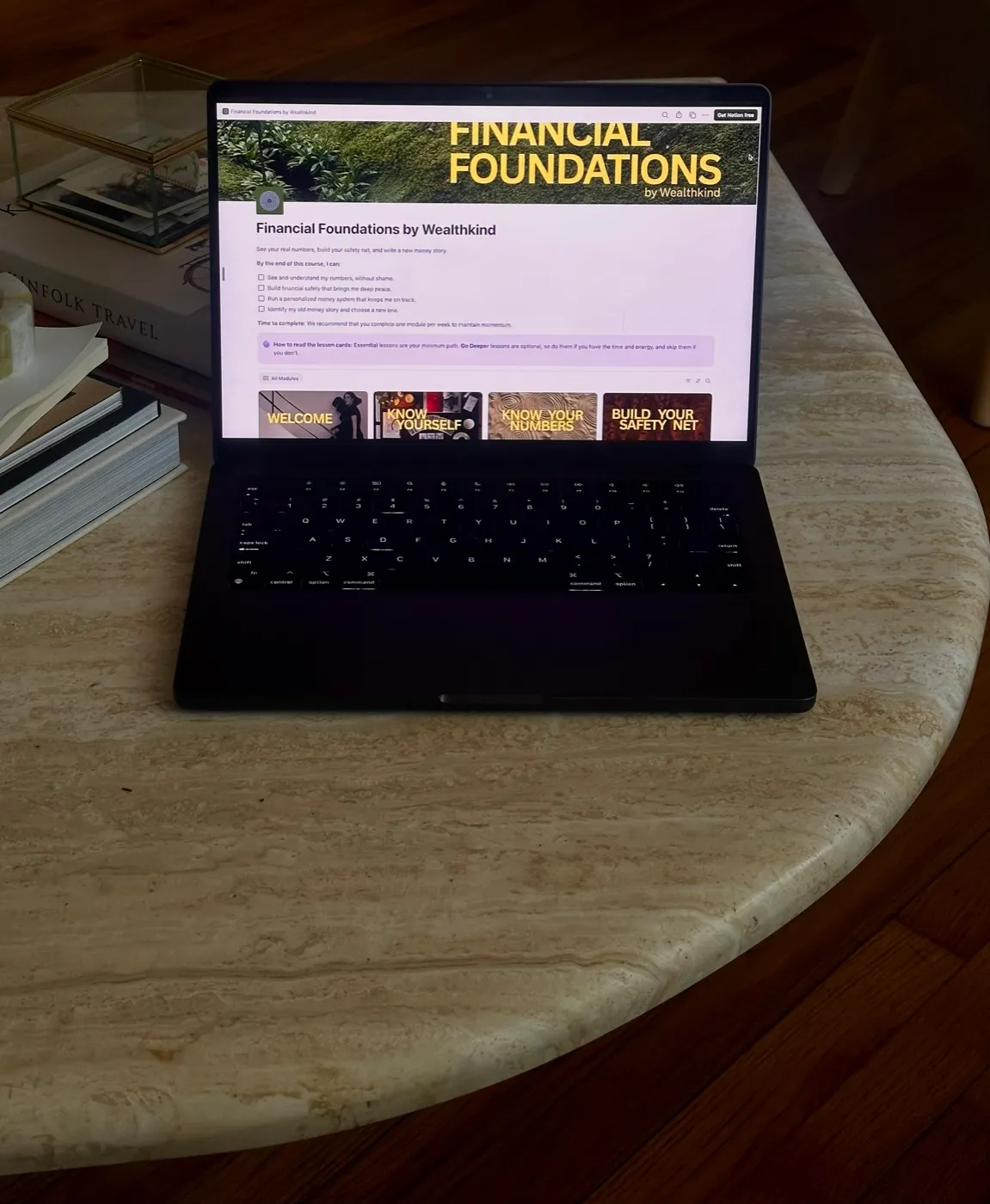
Financial Foundations includes four modules, four weeks of live group coaching with Lexi and Delana, and one Workbook that finally makes your numbers make sense and is easy to use.

Name the money story you inherited, keep what fits, and get clear on the values behind every money decision.

See what you earn, spend, save, and owe, without judgment. Look for patterns, not problems.

Find your emergency fund number, open a high-yield savings account, and automate your savings, plus make a plan for high-interest debt.

Give every dollar a home, turn up the money dial on what brings you joy, and set up a weekly money date to keep your system going.
$697
or payment plans from $130/month
FAQ
A lot of our past students came into Financial Foundations with debt, and used the course to establish a sustainable plan for that debt. Payment plans start at $130/month, and the debt module is included.
No. The course is on-demand, so you start wherever you are. Group coaching is for the questions you've been too hesitant to ask anywhere else.
If you already know your numbers, have an emergency fund, and run a money system you trust, you're ready for Intentional Investing instead. If any of those are shaky, start here.
Information alone doesn't stick, but practice plus live support does. Every lesson has you working with your own numbers, and you have four weeks of live group coaching to bring what comes up.
About 20 hours across four modules, mostly activities and readings you do with your own numbers. Go at your own pace.
Live on Zoom on Thursdays for four weeks, starting about a week after you enroll.
Yes. Pay $697 in full, or choose a payment plan from $130/month.
All sales are final. If you're not sure Financial Foundations is right for you, book a free 15-minute call first.
No. Financial Foundations is education, not financial advice: we teach you how money works, and you make the decisions. We cover investing in its own course, Intentional Investing.
Financial Foundations and Intentional Investing together for $1,500, almost $200 less than buying them separately, with 8 weeks of live group coaching with Lexi and Delana instead of 4. Start with Financial Foundations now, and Intentional Investing opens when doors open.
Start today. Your first live group coaching session is about a week away.